
Traffic You Never See: AI Hiding Best Customers
Traffic You Never See:
AI Hiding Best Customers
By Shane H. Tepper, Founder, Resonate Labs
Edited by Dr. Terry Kibiloski, Computer Times

Every business with a website checks the same thing: how many visitors showed up today? Where did they come from? Did they buy anything?
Those numbers live inside a tool called web analytics. Think of it as a visitor log for your website. Every time someone clicks a link and lands on your page, the analytics system writes it down. It notes where they came from (a Google search, a Facebook ad, a link in an email) and what they did once they arrived.
For decades, this system worked well enough. You could look at the data and say, “Okay, 40% of our visitors found us through Google.” That wasn’t a perfect picture, but it was a usable one.
That picture is now significantly broken. And AI is the reason.
What Is “Dark Traffic”?
Dark traffic is web traffic that arrives at your site with no record of where it came from.
The name makes sense once you understand how analytics works. Every visitor who arrives at your site is supposed to carry a tiny piece of information with them: a “referrer,” which is basically a digital sticky note that says, “This person came from Google” or “This person clicked a link on LinkedIn.” When that sticky note is missing, the visit gets logged as “direct” traffic, as if the person just magically appeared, knowing your web address by heart.
Some direct traffic is real. Maybe someone typed your URL from memory. Maybe they had it bookmarked. But a lot of what shows up as “direct” is actually dark traffic (visits where the referral information got lost or never existed in the first place).
This has always been a minor problem, but AI has turned it into a major one.
How AI Research Actually Works
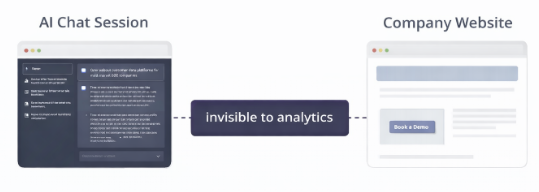
Here’s a scenario that plays out thousands of times every day.
A marketing director at a mid-size company needs to find a new customer data platform. She opens ChatGPT and types: “What are the best customer data platforms for mid-market B2B companies?”
ChatGPT responds with a detailed answer. It names several vendors, explains what each one does well, compares their pricing models, and notes which ones tend to get strong reviews from companies like hers. She asks follow-up questions. She spends 20, 30, 45 minutes or more in this conversation.
By the end, she has a mental shortlist of three vendors. One of them is your company.
She closes ChatGPT and gets back to her day.
Four days later, she types your URL directly into her browser and books a demo.
What does your analytics system record? A direct visit. No referrer. No record of ChatGPT. No record of the conversation that put you on her shortlist.
That’s dark traffic. The entire research session that built her confidence in your brand is completely invisible to your data.
Why AI Makes This Worse Than Ever
Dark traffic existed before AI search tools. But it was manageable. Most of the time, people found websites through Google, clicked a link, and the referral got recorded correctly.
AI assistants like ChatGPT, Perplexity, and Google’s AI Overviews work differently. They’re designed to give you a complete answer inside the tool itself. You don’t need to click anywhere. You can research three vendors, compare their pros and cons, read summaries of customer reviews, and build a shortlist without ever leaving the AI interface.
When users do eventually visit a website they discovered through AI, there’s often no link to click and track. They either type the URL themselves or search for the company name separately. Either way, the connection back to the AI session is gone.
Independent tracking has consistently placed AI search at under 1% of recorded site visits, even as billions of AI interactions happen every week. Most of them never produce a click.
Ahrefs confirmed this problem in a December 2025 study. Their research found that even when a user clicks directly from a Google AI Overview (Google’s built-in AI summary at the top of search results) to a website, that visit appears in analytics as standard Google organic traffic. There is no way to tell, using Google’s own tools, that the visit came from an AI-generated answer rather than a traditional search result.
The influence gets hidden inside traffic categories you think you already understand.
The Specific Problem for Businesses
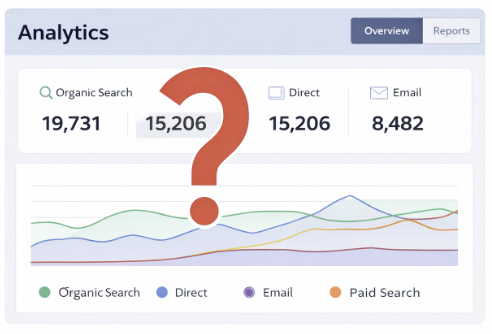
Here’s where it gets costly.
Most businesses make marketing decisions based on their analytics data. If email campaigns seem to drive lots of visitors, they invest more in email. If Google search traffic is strong, they invest in search optimization. They follow the data.
But if a large and growing share of their best visitors are arriving through AI research sessions that never get recorded, the data is wrong in a specific and dangerous way: it systematically underestimates AI’s role in bringing customers in.
Teams look at their AI referral traffic (which genuinely looks small in their reports) and conclude that AI tools aren’t affecting their business much. Meanwhile, the buyers who researched them through ChatGPT are showing up in analytics under different labels: organic search, direct visits, email clicks. The credit goes somewhere else entirely.
My research with client companies finds this pattern consistently. One mid-market software company had 50% visibility across the queries their buyers were asking in AI tools: their name appeared in AI answers for half the relevant questions. But their existing analytics gave no indication of this whatsoever. The AI sessions were invisible.
In a separate client audit, a company appeared in AI responses for half of 150 buyer queries, yet their actual win rate on those queries (the share where they were specifically named as a recommendation) was just 14.7%. That entire gap was invisible in their standard reporting until we ran the AI audit.
“But I Can Still See Some AI Traffic”
You can. Tools like ChatGPT do send some referral traffic that gets recorded properly. You might see a trickle in your analytics labeled as coming from chat.openai.com or perplexity.ai.
That trickle is real. But it only represents a small fraction of AI’s actual influence.
Think of it like this: imagine a trusted colleague recommended your company to a dozen different people in private conversations over the past month. Some of those people eventually contacted you. Your analytics can record that they contacted you, but it has no way of knowing your colleague’s recommendation had anything to do with it.
AI is now playing the role of that colleague, at enormous scale. ChatGPT alone receives 2.5 billion user prompts every day. Your current tools weren’t built to see any of it.
What Businesses Can Do About It
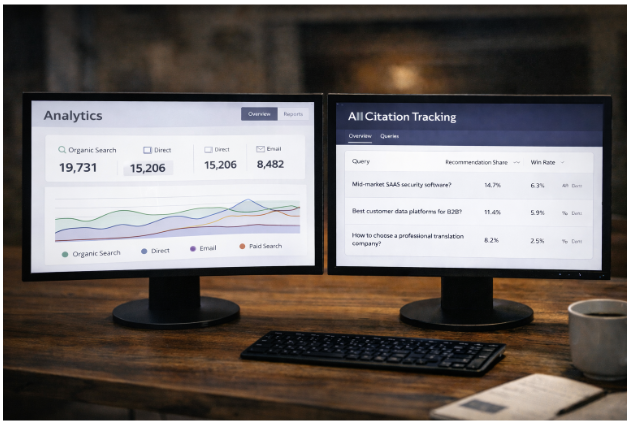
The first step is simply understanding that the problem exists. Most businesses are flying blind on AI-driven demand right now, not because the demand isn’t there, but because their measurement tools predate the phenomenon.
A few practical adjustments can help:
Check where AI mentions you, and at what stage. Several existing GEO tools let you run queries across major AI platforms and see how often your brand appears. But the more important question is when in the buying process you appear. A brand that shows up consistently when buyers are comparing vendors is in a very different position than one that only shows up after a shortlist has already been formed. Buyers who find you late rarely reconsider. Knowing which stage you’re visible at changes what you do next.
Pay closer attention to branded searches and direct traffic. When AI drives a buyer to look you up, they often do it by typing your brand name into a search engine or directly into their browser. If your branded search volume or direct traffic is growing without an obvious explanation, AI visibility may be a contributor.
Focus on the quality of information AI has about you. AI tools build their answers from publicly available content: your website, industry publications, customer reviews, press mentions. The more clearly and accurately that information describes what you do and who you serve, the more likely AI answers will reflect you accurately. AI search traffic, while currently undercounted, converts at 4.4 times the rate of traditional organic search when it does get measured, so even a small improvement in AI visibility can move the needle.
None of this is simple. The measurement gap between what AI does and what analytics records is one of the harder problems in digital marketing right now, and no one has published a perfect solution. But knowing the gap exists is the necessary first step toward closing it.
The Bigger Picture
For most of internet history, the path from “customer first learns about your company” to “customer arrives at your website” was visible and trackable. AI has inserted an invisible middle step. The research happens. The shortlist gets built. The decision gets made. None of it shows up in your data.
AI search traffic is growing 165 times faster than traditional organic search. Buyers, shoppers, and decision-makers of every kind are using these tools to research their options before they ever visit a website.
That means a growing share of the most important customer journeys are starting in a place businesses currently can’t see.
The traffic is real. The customers are real. The influence on their decisions is real. It just doesn’t show up in the report.
Shane H. Tepper is the founder of Resonate Labs, a generative engine optimization consultancy, and the author of Cited: How B2B Brands Win in the Age of AI-Generated Answers (available on Amazon Kindle).
Sources
Tepper, Shane H. Cited: How B2B Brands Win in the Age of AI-Generated Answers, Chapter 3: Dark Traffic. Retina Media LLC, 2026. https://retina.media/cited
Ahrefs. “Update: AI Overviews Reduce Clicks by 58%.” December 2025. https://ahrefs.com/blog/ai-overviews-reduce-clicks-update/
Muñoz, Benni. “ChatGPT Users Send 2.5 Billion Prompts a Day.” TechCrunch, July 21, 2025. https://techcrunch.com/2025/07/21/chatgpt-users-send-2-5-billion-prompts-a-day/
Semrush. “We Studied the Impact of AI Search on SEO Traffic. Here’s What We Learned.” June 2025. https://www.semrush.com/blog/ai-search-seo-traffic-study/
WebFX. “Gen AI’s 165x Faster Growth Over Organic Signals a Shift in Search.” 2025. https://www.webfx.com/blog/seo/gen-ai-search-trends/